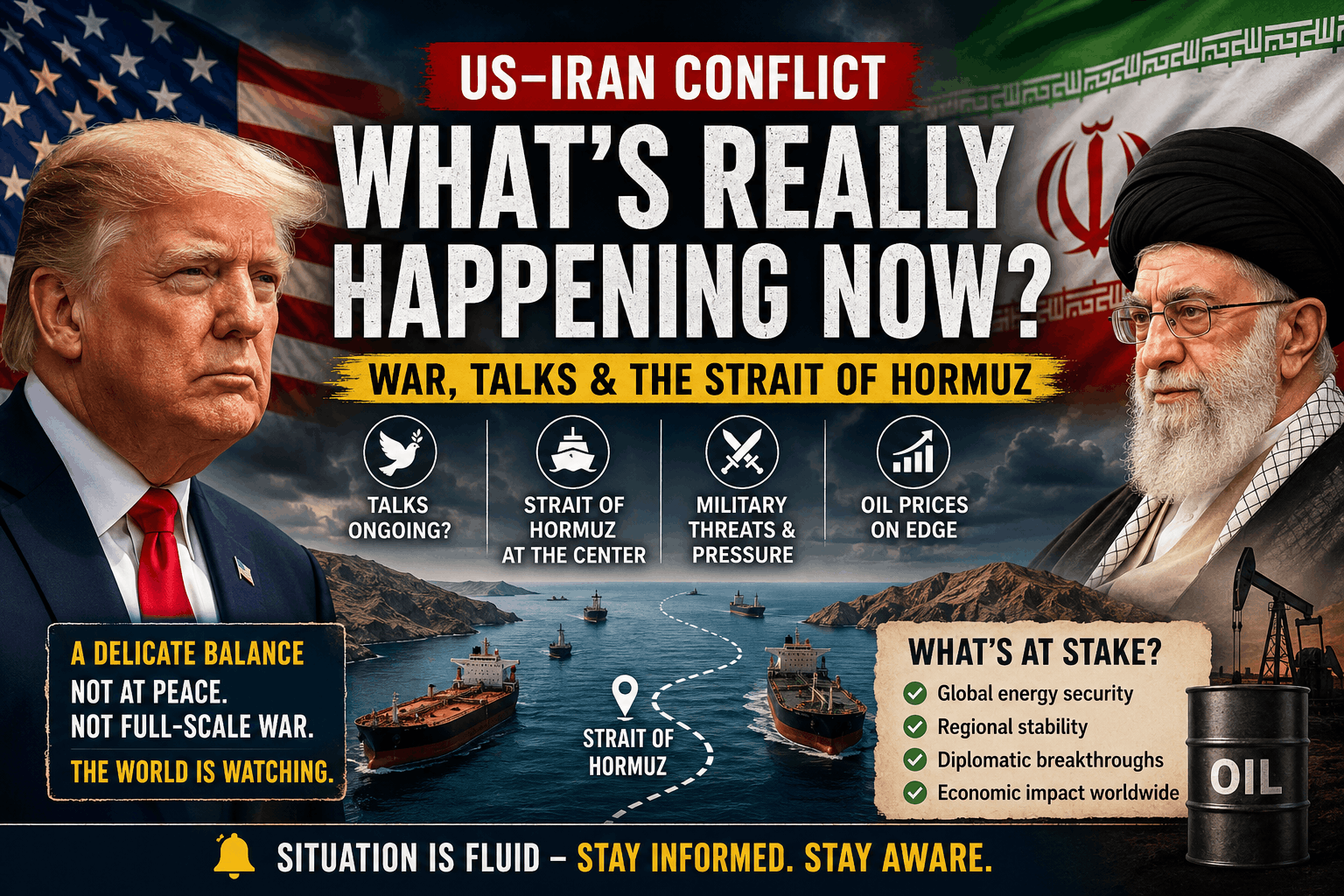
I’ll be honest — every time I open the news these days, there’s a new headline about Trump and Iran. One day it’s “war could end soon,” the next day it’s “attack imminent.” It got confusing enough that I sat down and read through a week’s worth of updates just to make sense of it myself.
Here’s where things actually stand, as simply as I can put it.
What’s Happening Between the US and Iran Right Now
As of early August 2026, the US and Iran are in a strange in-between phase — not quite at peace, not in full-scale war either. President Trump has gone back and forth multiple times: threatening massive strikes one week, then canceling them days later, citing progress in talks.
In early August, Trump said the US was fully prepared to hit Iran with unprecedented military force, but then said he’d agreed to hold off to allow room for a deal. He’s repeated a similar pattern several times over the past few months — escalate, then pull back at the last moment when a diplomatic opening appears.
The Strait of Hormuz Is at the Center of It All
A huge part of this conflict revolves around the Strait of Hormuz, one of the world’s most important oil shipping routes. Its closure earlier this year triggered a global energy crisis and sent oil prices swinging.
By early August, Iran and Oman were reportedly close to agreeing on coordinates for safe shipping routes through the strait. That’s a meaningful step, but officials have been careful to note that an agreement on shipping lanes doesn’t automatically mean the strait fully reopens.
Is There Actually a Deal Happening?
This is where things get murky. Trump has repeatedly claimed that negotiations with Iran are underway and going well. Iran’s Foreign Ministry, on the other hand, has denied that direct talks are taking place, though Iranian officials have acknowledged that mediators are working behind the scenes to pass messages between both sides and ease tensions.
So depending on which side you ask, the two countries are either close to a deal or barely speaking. The truth is probably somewhere in between indirect, mediated contact rather than a formal negotiating table.
Pressure Is Building on Both Sides
A few things are worth knowing if you want the full picture
- The US has reportedly faced questions about its military stockpile after months of sustained conflict, something officials have pushed back on publicly.
- Iran-linked groups in the wider region, including in Yemen and among Iraqi militias, have continued to carry out attacks, keeping the conflict from staying contained to just the US and Iran.
- Gulf countries like Saudi Arabia have expressed concern about being drawn further into the fighting.
- Oil prices have been reacting sharply to every twist in the story, since so much of global shipping depends on this region staying stable.
Why This Keeps Escalating and De-escalating
If you’re wondering why this war seems to swing wildly from “about to explode” to “close to a deal” every few days, you’re not imagining it. Trump has used the threat of overwhelming force as leverage repeatedly, only to step back when regional allies or Iran itself signal openness to talks. Military leaders have also reportedly pushed for finding a way to wind the conflict down rather than let it keep expanding.
That push-and-pull is likely to continue until either a real agreement is signed or something forces a bigger escalation.
The two countries are in an active but unresolved conflict. Military threats, limited strikes, and diplomatic back-and-forth have continued for months without a formal resolution.
It’s one of the world’s busiest oil shipping routes. Its disruption has affected global oil prices, and reopening it safely is a central part of any potential deal between the US and Iran.
Reports are mixed. The US has claimed progress multiple times, while Iran has denied that direct negotiations are happening. Indirect, mediated talks appear to be ongoing.
Oil prices have moved up and down sharply in response to news about the strait and the broader conflict, since any disruption to Gulf shipping routes affects global supply.
Where This Leaves Us
Conflicts like this rarely move in a straight line, and this one has been especially unpredictable — threats one day, talk of peace the next. What seems clear is that both sides are under pressure to find some kind of resolution, even if neither wants to be the one seen backing down first.
This is a fast-moving situation, so it’s worth checking trusted news sources for the latest developments rather than relying on any single update, including this one.
Sources: CNN, Al Jazeera — reporting as of August 8, 2026. This article summarizes publicly reported news and does not represent original, on-the-ground reporting.